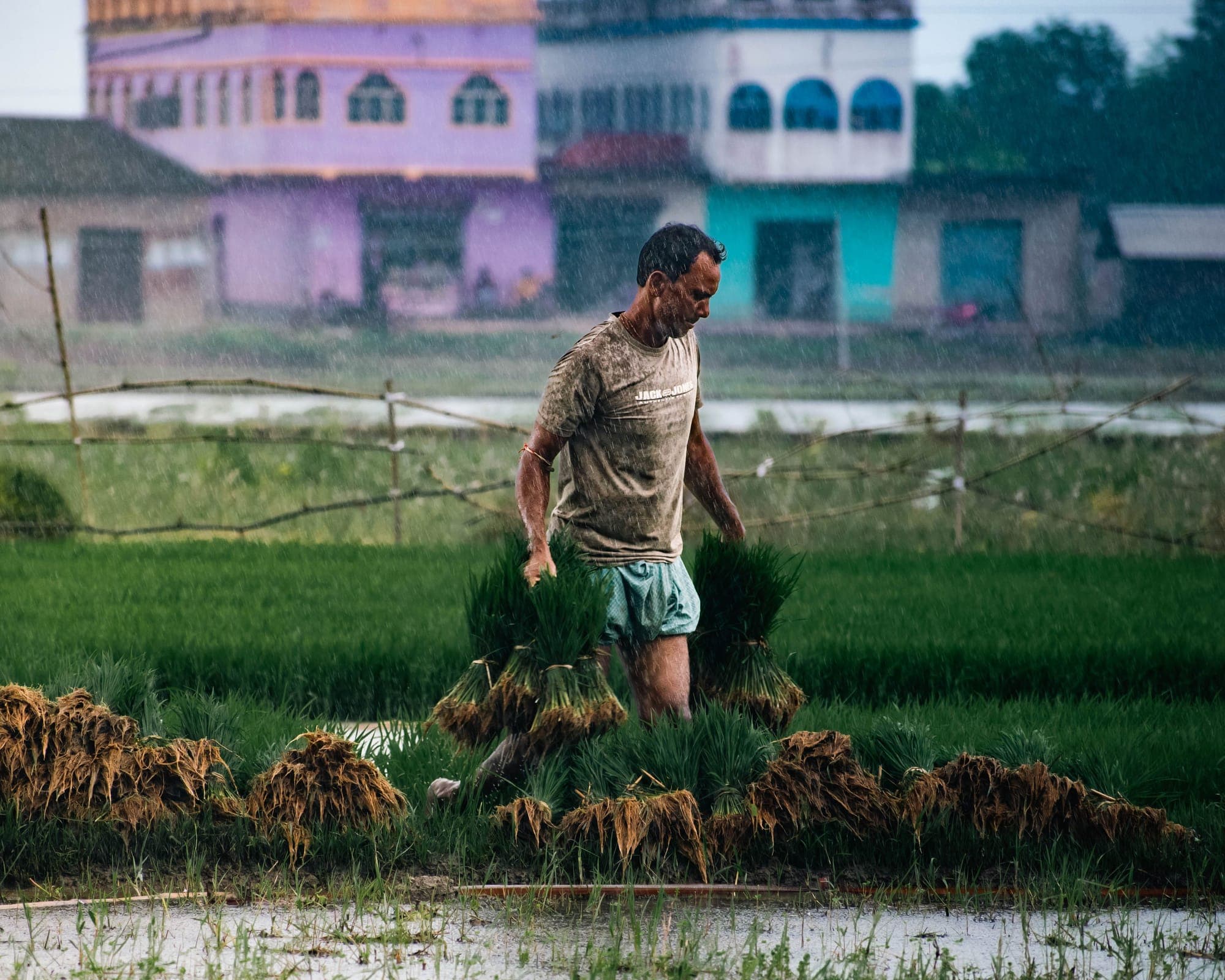
Before the Monsoon: Why India Needs Climate-Linked Financial Resilience
The IMD's April 2026 long-range forecast projected southwest monsoon rainfall at 92% of the Long Period Average, with El Niño conditions potentially developing by July.
But a national forecast tells only part of the story.
In 2025, even an above-normal monsoon left 146 districts with deficient or large-deficient rainfall.
For farmers, lenders, and businesses dependent on agriculture, this creates a simple lesson:
Preparing for monsoon risk cannot wait until the rain arrives.
The financial impact of climate shocks is often determined before the event itself—by whether households and businesses have access to liquidity, insurance, and other climate resilience financing solutions when conditions deteriorate.
India's monsoon creates recurring financial risk for farmers and businesses. Climate-linked insurance can provide faster protection before losses occur.
Written byAnupam ShreyFounder & CEO

Why the Monsoon Creates an Annual Financial Risk for Millions
India's Kharif crop season runs broadly from June to September.
Paddy, maize, pulses, cotton, and several other crops depend heavily on the timing, distribution, and intensity of monsoon rainfall.
A rainfall deficit of 20–59% from the long-period average is classified as "deficient" under IMD's rainfall classification.
But the problem is not simply too little rain.
Too much rain can be equally damaging.
Heavy rainfall can waterlog fields, destroy standing crops, damage roads, interrupt supply chains, and prevent workers from reaching their workplaces.
This means the same monsoon can create very different financial outcomes across India.
One district can experience drought conditions while another faces flooding.
That geographic variability creates a difficult problem for conventional financial planning.
The financial consequences extend beyond agriculture.
India's microfinance sector had a gross loan portfolio of approximately ₹3.81 trillion as of March 2025, with around 60% concentrated in agriculture and allied activities.
When climate events reduce farm income, repayment capacity can deteriorate at the same time across thousands of borrowers.
This creates correlated climate credit risk for lenders.
The consequence is a cycle:
Weather shock → income loss → repayment stress → loan stress → reduced access to future credit
Climate-linked financial protection can help interrupt that cycle.
India's Monsoon Is Not One Risk
The 2025 monsoon demonstrated just how geographically uneven India's rainfall can be.
Several major cities, including Delhi, Mumbai, and Kolkata, experienced rainfall excess of 20% or more above normal.
Excess rainfall caused urban flooding, disrupted transport, and prevented many workers from reaching workplaces.
At the same time, 135 districts recorded rainfall deficits of 20–59%.
Another 11 districts experienced large rainfall deficits of 60–99%.
The result was a fragmented climate-risk landscape.
There is no single "Indian monsoon risk."
There are hundreds of localised rainfall and financial-risk profiles playing out simultaneously.
This is why increasingly granular climate data is becoming important for insurance, lending, and financial planning.
What Rain Insurance for Farmers Does
Rain insurance for farmers, also known as rainfall index insurance or parametric crop insurance, works differently from conventional indemnity-based insurance.
Traditional crop insurance generally assesses the loss experienced by the policyholder.
Parametric insurance works differently.
The policy defines an objective weather trigger in advance.
For example:
If rainfall during June falls below a specified threshold relative to the long-period average, a predefined payout is triggered.
The payout is therefore determined by the agreed weather index rather than a post-event assessment of individual crop damage.
The mechanism can be summarised simply:
Weather data → Trigger breached → Automatic payout
Depending on the product design, the underlying data can come from sources such as IMD weather stations, automated weather stations, satellites, or other approved data sources.
This simplicity is particularly relevant for smallholder farmers who may not have the time, documentation, or resources required to navigate a lengthy conventional claims process.
A Real Example of Rainfall-Triggered Protection
Nagaland provides an example of how rainfall-triggered protection can be implemented at a state level.
The state developed a parametric insurance scheme using IMD data alongside its own automated weather stations.
In March 2025, the programme reportedly paid out more than ₹1 crore to residents affected by the 2024 monsoon.
The significance is not simply the amount paid.
It demonstrates how objective weather data can be connected directly to financial protection.
For consumers looking to buy climate insurance online in India, private-sector parametric products are also emerging.
Bajaj General Insurance's ClimateSafe product, for example, has been designed around weather-linked protection against hazards including floods, droughts, and extreme heat.
The broader market is moving toward products that connect climate events directly with income protection.
What Changes for Farmers and Lenders When Protection Exists?
The biggest difference is liquidity.
After a severe weather event, a farmer may need money immediately to:
- Purchase seeds and agricultural inputs.
- Repair equipment or infrastructure.
- Cover household expenses.
- Repay an upcoming loan instalment.
- Finance the next crop cycle.
A conventional insurance settlement may take considerably longer because it can involve damage assessment and claims processing.
A parametric payout can be triggered automatically once the agreed weather condition is verified.
That makes the timing of the protection fundamentally different.
Climate Protection Can Also Strengthen Agricultural Lending
The implications extend beyond the farmer.
For lenders, the central question is:
What happens to repayment capacity after a climate shock?
Consider two farmers with similar financial profiles.
Both cultivate the same crop in the same district.
One has appropriate parametric rainfall protection.
The other does not.
If a severe drought occurs, the insured farmer may receive a predefined payout that provides liquidity during the period of income disruption.
The insurance does not make the borrower risk-free.
But it can create an additional financial buffer between the climate event and a missed repayment.
This is where climate-smart agriculture finance becomes important.
Lenders can potentially incorporate climate exposure and insurance protection alongside conventional credit indicators when evaluating agricultural borrowers.
The objective is not simply to lend more.
It is to understand which borrowers have mechanisms to absorb climate shocks and recover from them.
Climate Resilience Extends Beyond Farmers
Agriculture is only one part of the equation.
Businesses throughout the agricultural value chain are also exposed to monsoon variability.
These include:
- Food processors
- Agricultural traders
- Input suppliers
- Warehousing businesses
- Transport operators
- Rural retailers
- Small manufacturers
A failed crop can reduce demand for agricultural inputs.
Flooding can interrupt transport.
Excess rainfall can disrupt manufacturing.
Drought can increase input costs.
For these businesses, climate resilience financing solutions can provide an additional financial buffer against weather-driven revenue disruptions.
The principle remains the same:
Climate shock → Financial disruption → Protection → Faster recovery
Where Parametric Monsoon Insurance Falls Short
Parametric insurance is not a perfect solution.
The most important limitation is basis risk.
Basis risk occurs when the weather index used by the policy does not accurately represent the actual conditions experienced by the policyholder.
For example, a district may record rainfall above the policy's trigger threshold even though a specific farm receives substantially less rainfall.
The farmer may experience crop stress but receive no payout because the agreed trigger was not breached.
This becomes more significant as the geographic area covered by the weather index becomes larger.
A district-level rainfall average can hide substantial variation between:
- Blocks
- Villages
- Farms
- Different soil types
- Different crop conditions
This makes trigger design and data resolution critical.
Premium Affordability Also Matters
For small and marginal farmers, even a relatively low insurance premium can compete with other immediate household and agricultural expenses.
For climate insurance to achieve meaningful adoption, products need to balance:
Affordability + Coverage + Trigger accuracy + Payout adequacy
A product that is technically sophisticated but unaffordable will not create meaningful resilience.
Similarly, an inexpensive product with poorly designed triggers may fail when customers need it most.
What Should Farmers and Businesses Look for Before Buying?
Anyone considering climate insurance in India should understand the mechanics before purchasing a policy.
Key questions include:
What exactly triggers the payout?
Understand whether the policy responds to rainfall, temperature, flood conditions, or another measurable index.
What is the data source?
Check whether the trigger is based on an IMD station, automated weather station, satellite, or another recognised data source.
Where is the trigger measured?
A district-level trigger and an asset-level trigger can produce very different outcomes.
How much is the payout?
The payout amount should be clear before purchasing.
How quickly is the payout made?
Understand the expected timeline after the trigger is verified.
What happens if the actual loss occurs but the trigger is not breached?
This is the key basis-risk question.
Understanding these terms is particularly important when comparing products online.
Wrapping Up: Protecting Income Before the Monsoon Arrives
India's monsoon is not one weather event.
It is hundreds of localised weather systems affecting farmers, workers, businesses, lenders, and supply chains differently.
One district can experience excess rainfall while another faces severe drought.
That makes a single national approach to climate risk insufficient.
Climate resilience financing solutions are therefore becoming increasingly important—not as a replacement for traditional insurance or government support, but as an additional financial layer that can respond quickly when measurable climate shocks occur.
For farmers, the value is liquidity.
For lenders, it can provide an additional layer of borrower resilience.
For businesses, it can help absorb weather-driven income volatility.
And for financial institutions, it creates a pathway toward more climate-aware lending and insurance.
With the IMD's 2026 forecast pointing toward below-normal monsoon rainfall and the possibility of El Niño conditions developing during the season, the case for preparing before the climate shock becomes more compelling.
The most effective climate protection is not necessarily the product that responds fastest after a disaster.
It is the financial resilience that is already in place before the rain arrives.
Ready to Make Your Income More Monsoon-Resilient?
If you are a farmer, lender, or business exposed to monsoon risk, understanding available rain insurance for farmers and other parametric products is a practical first step.
Compare the trigger, coverage, data source, payout amount, and basis-risk implications before choosing a product.
Climate risk cannot be eliminated.
But the financial consequences of that risk can be planned for.
00 Comments
Start the conversation
Be the first reader to share a thoughtful response.
Leave a Reply
Your email address will not be published. All comments are reviewed before appearing publicly.